



As experienced email marketers, we’ve tested, reviewed, and analyzed nearly every major email platform out there — from beginner-friendly tools to enterprise-grade automation systems.
After working hands-on with 30+ email marketing platforms, we know exactly what matters: deliverability, automation power, usability, and value for money.
In this guide, we’ll share our in-depth insights to help you choose the right email marketing software for your business in 2025 — backed by real data, practical experience, and unbiased testing.
Whether you’re a small business owner, content creator, or marketing professional, this review will show you which tools deserve your investment — and which ones don’t.
 How We Test and Review These Email Platforms
Our goal is to give you accurate, actionable, and up-to-date information. To do that, each platform is tested using the same process:
-
Hands-on Setup & Ease of Use:
We evaluate how quickly you can create and send your first campaign, design templates, and manage subscribers. -
Automation & Workflow Testing:
We test automation builders, triggers, segmentation logic, and behavior-based emails to measure depth and reliability. -
Deliverability & Performance:
Using real test campaigns, we track inbox placement rates, bounce handling, and overall deliverability performance. -
Integrations & Features:
We verify integrations with CRMs, e-commerce platforms, and analytics tools, plus advanced features like SMS and AI. -
Pricing & Scalability:
We analyze pricing transparency, contact limits, and how cost scales as your list grows — because affordability matters long-term. -
Customer Support & Documentation:
Every tool is scored for quality of documentation, tutorials, chat/email support, and community presence.
Each platform earns a performance score based on these categories so our readers can compare fairly — not just by popularity, but by proven results.
 Why You Can Trust Our Reviews
We don’t publish generic summaries or sponsor-biased lists.
Our content is written and verified by marketers with years of direct campaign experience — people who’ve actually used these tools for real clients and brands.
Here’s how we stay transparent:
-
No Paid Bias: Tools can’t buy their spot on our list. Rankings are based solely on merit, data, and testing.
-
Updated Data: We refresh pricing, features, and screenshots regularly to reflect the latest 2025 updates.
-
Affiliate Disclosure: Some links may be affiliate links (including Brevo), but this doesn’t influence our opinions.
We recommend tools that genuinely deliver value to users.
Our mission is simple: to save you hours of research and help you make smarter, data-driven marketing decisions.
 Ready to Find Your Perfect Email Marketing Platform?
Now that you know how we test and rank these tools, let’s explore the best email marketing platforms in 2025 — their key features, pros & cons, and real pricing data to help you choose confidently.
 13 Best Email Marketing Platforms Overview (2025 Edition)
Over the years, I’ve used nearly every email marketing tool on the market — from simple newsletter senders to enterprise-level automation suites. One thing I’ve learned?
The best email marketing platforms combine powerful features with simplicity — helping you create, send, and automate campaigns without getting lost in technical complexity.
A great email marketing tool should make it effortless to:
-
Design stunning HTML emails without touching a line of code.
-
Automate follow-ups, welcome sequences, and behavioral campaigns.
-
Segment and target the right audience with the right message at the right time.
While these goals are common, not every platform executes them equally. Some excel in automation and analytics; others focus on ease of use, integrations, or value for money.
To save you time, we reviewed 35+ platforms and shortlisted the 14 best email marketing services for 2025 — tested for performance, usability, automation, pricing, and deliverability.
Below is a quick summary of our top picks before we dive into detailed reviews.
 Quick Comparison: Top 13 Email Marketing Platforms 2025
| Platform | Best For | Free Plan / Trial | Starting Price | Overall Rating |
|---|---|---|---|---|
| MailerLite | Getting started with email marketing |  Yes Yes |
$9/mo |  4.5 / 5 4.5 / 5 |
| Brevo (Sendinblue) | Free, multi-channel email marketing | Yes |
$8.08/mo | 4.5 / 5 |
| ActiveCampaign | Advanced marketing automation | 14-day trial |
$15/mo | 4.5 / 5 |
| beehiiv | Newsletter creation & monetization | Yes |
$43/mo | 4.5 / 5 |
| Moosend | Small business automation | 30-day trial |
$7/mo | 4.5 / 5 |
| HubSpot | All-in-one CRM & email platform | Yes |
$20/mo | 4.5 / 5 |
| Omnisend | E-commerce marketing | Yes |
$16/mo | 4.5 / 5 |
| AWeber | Email design & simplicity | Yes |
$12.50/mo | 4 / 5 |
| Kit | Creators & subscriber growth | Yes |
$39/mo | 4 / 5 |
| Mailchimp | General use & integrations | Yes |
$13/mo | 4 / 5 |
| Campaigner | Enterprise-level automation | 30-day trial |
$59/mo | 4 / 5 |
| GetResponse | Marketing automation & webinars | Yes |
$15/mo | 4 / 5 |
| Constant Contact | Event & small business marketing | 14-day trial |
$12/mo | 3.5 / 5 |
| Benchmark Email | Simple, clean campaign builder | Yes |
$13/mo | 4.5 / 5 |
 What to Look for in an Email Marketing Platform
After testing dozens of tools, these are the six core features that separate the best email marketing software from the rest.
 Drag-and-Drop Email Builder
A powerful yet intuitive visual editor is a must. The top platforms let you design beautiful, mobile-responsive emails without coding.
I always look for clean UIs, reusable templates, and time-saving features like content blocks and pre-built layouts.
 User-Friendly Automation
Automation is where email marketing truly scales.
From welcome sequences to advanced customer journeys, automation should be visual, logical, and flexible.
The best tools (like Brevo, ActiveCampaign, and GetResponse) offer workflow builders that feel like you’re mapping your customer experience — not writing code.
 Landing Pages & Lead Capture Forms
Your email list is only as strong as your opt-ins.
A great platform should let you create landing pages, signup forms, and pop-ups directly inside the tool — without needing extra plugins.
Look for form automation, double opt-in options, and customizable landing page templates.
 Personalization & Segmentation
In 2025, personalization is the difference between campaigns that convert and campaigns that get ignored.
The best email marketing services allow you to segment contacts based on demographics, past engagement, or behavior — then personalize messages dynamically for each group.
 Flexible & Transparent Pricing
Cost should scale with your business, not against it.
Look for platforms that offer generous free plans or flexible pricing based on contacts or emails sent.
Transparent pricing and affordable entry tiers (like Brevo’s $8 plan) show that a company values small-business growth.
 Strong Deliverability & Infrastructure
Even the best email content fails if it doesn’t land in the inbox.
Deliverability depends on the provider’s sending reputation, infrastructure, and spam compliance.
Top performers maintain 98–99% inbox placement rates and provide tools for list hygiene, bounce management, and authentication (SPF, DKIM, DMARC).
13 Best Email Marketing Platforms in 2025
Now for the best bit. A detailed run-through of the key features, USPs, pros, cons, and prices of all 14 platforms. Based on my experiences using them.
 1. MailerLite — Best for Starting with Email Marketing
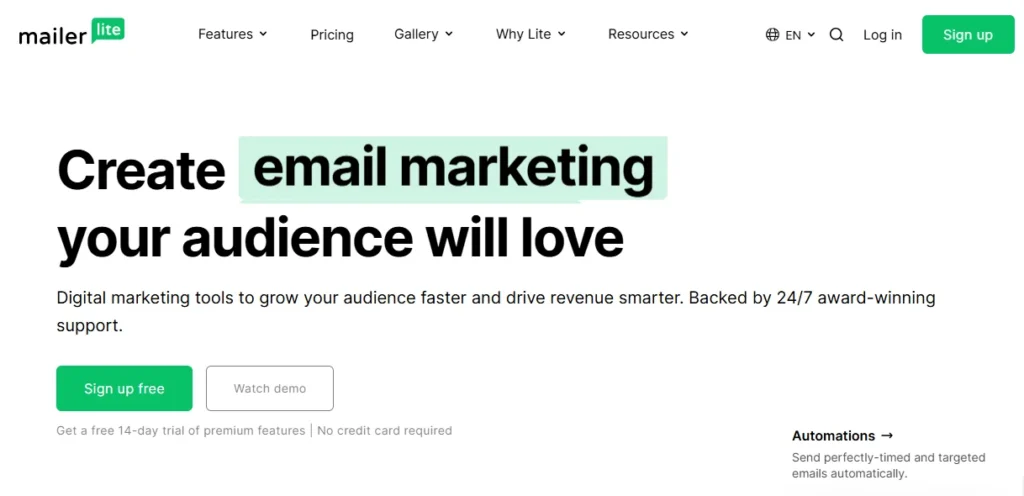
Ideal For: Beginners, bloggers, and small businesses looking for an affordable, no-nonsense way to launch professional email campaigns.
MailerLite continues to be one of the most approachable and cost-effective email marketing platforms on the market in 2025. It’s built for simplicity — every feature focuses on helping you create and send polished campaigns without needing technical experience.
 Ease of Use & Design
The platform’s drag-and-drop editor is a standout feature. It allows you to design eye-catching HTML emails in minutes, with access to 90+ modern templates. The interface feels clean, fast, and intuitive — perfect for marketers who want to focus on messaging rather than setup.
MailerLite also includes built-in signup forms, pop-ups, landing pages, and even a mini website builder, giving you everything you need to capture leads and grow your list.
Automation & Campaign Management
For the price, MailerLite’s automation tools punch above their weight. You can build smart workflows for:
-
Welcome sequences
-
Abandoned cart recovery
-
Lead-nurturing campaigns
-
Audience segmentation
Its visual automation editor makes setup effortless — ideal for small-to-midsize teams who want efficient workflows without enterprise-level complexity.
Deliverability & Performance
MailerLite has a strong reputation for high inbox placement rates, thanks to solid infrastructure and proactive deliverability management. Campaign analytics include open and click rates, geographic data, and automation reports that help you refine performance.
 Pricing (Updated for 2025)
-
Free Plan: Up to 1,000 subscribers & 12,000 emails per month
-
Growing Business Plan: Starts at $9/month with unlimited emails and 3 user accounts
-
Advanced Plan: Adds more automation features, priority support, and AI tools
Pricing remains one of the most attractive in its category — especially for small teams testing the waters.
MailerLite Pros
-
Intuitive drag-and-drop builder with 90+ templates
-
Affordable pricing & generous free plan
-
Solid automation for small business needs
-
Built-in landing pages, forms, and mini website creator
-
Excellent deliverability track record
 MailerLite Cons
-
Interface available in limited languages (only 3 as of 2025)
-
Lacks advanced enterprise-grade automation like ActiveCampaign
Verdict
MailerLite is the perfect entry point for marketers who want a reliable, budget-friendly solution that grows with them. It may not have every enterprise feature, but it nails the essentials — making it an excellent choice for freelancers, creators, and small businesses ready to start building their audience through email.
 2. Brevo — Best for Free Email Marketing & Multi-Channel Campaigns
Ideal For: Small businesses, eCommerce stores, and marketing teams that want to manage email, SMS, and CRM in one unified platform.
Brevo (formerly Sendinblue) continues to dominate as one of the best free email marketing platforms in 2025 — combining affordability, automation, and multi-channel communication in a single dashboard. It’s designed for marketers who want simplicity without sacrificing power.
Ease of Use & Interface
Brevo’s interface feels clean, intuitive, and well-structured. The drag-and-drop email editor makes campaign creation straightforward even for non-technical users. While the template library offers around 40+ pre-designed layouts, each is mobile-responsive and easy to customize.
Building your first campaign in Brevo takes minutes — from template selection to scheduling and segmentation. You can preview emails across devices and fine-tune personalization tags directly in the editor.
Automation & Workflows
Automation is one of Brevo’s biggest strengths. The platform supports website tracking, enabling triggers based on subscriber behavior (like page visits or abandoned carts).
It includes 12 pre-built workflow templates that cover:
-
Lead nurturing & welcome series
-
Abandoned cart recovery
-
Personalized follow-ups
-
Engagement reactivation sequences
Each workflow is visual and modular — you can easily add filters, delays, or conditions. Brevo’s automation tools rival those of higher-priced competitors such as ActiveCampaign, making it a great mid-range option for both beginners and experienced marketers.
 Multi-Channel Communication
Brevo goes beyond standard email. It’s a true omnichannel marketing solution, offering:
-
SMS & WhatsApp messaging
-
Transactional emails (order confirmations, invoices, shipping updates)
-
Live chat and CRM features for real-time customer tracking
This makes it an excellent all-in-one tool for businesses wanting to consolidate marketing and sales communication under one roof.
Pricing & Free Plan (2025 Update)
Brevo’s pricing remains among the most generous in the industry.
| Plan | Key Features | Monthly Cost* |
|---|---|---|
| Free Plan | 100,000 contacts, 300 emails/day, multi-channel messaging (email, SMS, WhatsApp), basic CRM | $0 |
| Starter | 5,000 emails/month, unlimited contacts, no daily limit | $8.08/month |
| Business / Enterprise | Advanced automation, AI optimization, dedicated IP, sub-account management | Custom |
Unlike most competitors, Brevo charges by email volume — not contacts. That means even the most affordable plan supports up to 500,000 contacts without extra cost. It’s perfect for growing businesses that need flexibility.
Brevo Pros
-
Industry-leading free plan with generous limits
-
Low starting price and high scalability
-
Easy-to-use drag-and-drop email builder
-
Advanced automation & workflow templates
-
Built-in CRM, transactional email, SMS, and WhatsApp campaigns
-
Excellent deliverability and reliability
Brevo Cons
-
Smaller email template library compared to some rivals
-
Advanced analytics and A/B testing only in higher tiers
Verdict
Brevo stands out as a top free email marketing platform and an ideal starting point for businesses wanting to automate marketing affordably.
Its combination of email, SMS, CRM, and automation tools delivers remarkable value for money.
If you’re looking for an all-in-one solution that grows with your audience — without paying premium enterprise prices — Brevo should be at the top of your list for 2025.
 3. Moosend — Best for Small Businesses on a Budget
Ideal For: Small to midsize businesses, startups, and solopreneurs who want affordable yet powerful automation.
Moosend has built a reputation as one of the most budget-friendly email marketing platforms available — but don’t mistake its low cost for limited functionality. In 2025, Moosend continues to impress with its mix of automation depth, personalization, and user-friendly design that rivals many higher-priced competitors.
 Intuitive Design & User Experience
Moosend shines in usability and design consistency. Every feature — from campaign creation to landing page and form design — uses the same clean, drag-and-drop interface.
This makes onboarding fast and frictionless. Even if you’ve never used an email tool before, you’ll feel comfortable within minutes. The templates are modern, responsive, and adaptable to any niche, from e-commerce to content marketing.
The no-code email builder, landing page creator, and signup form tools are visually cohesive and extremely beginner-friendly, while still offering enough flexibility for advanced marketers.
Automation & Personalization
For a platform at this price point, Moosend’s automation capabilities are surprisingly advanced.
The visual automation builder lets you craft multi-step workflows using 25+ triggers, including user behavior, time delays, form submissions, and even website tracking.
This means you can:
-
Send automated product recommendations based on browsing activity
-
Trigger drip campaigns after page visits or abandoned carts
-
Update contact data dynamically to improve segmentation
Personalization goes beyond first names — Moosend lets you tailor entire messages based on customer actions, preferences, or previous engagement.
Pricing & Plans (Updated for 2025)
Moosend offers one of the most straightforward pricing models in the industry. All Pro users get full access to every feature — automation, segmentation, landing pages, and reporting. You only pay more as your contact list grows, not to unlock extra functionality.
| Plan | Contacts | Monthly Cost* | Key Features |
|---|---|---|---|
| Pro Plan | 500 contacts | $7/mo | All features included, unlimited emails |
| Pro Plan (Scalable) | 5,000 contacts | ~$40/mo | Full access, advanced workflows |
| Enterprise | Custom | Custom pricing | Dedicated IP, account manager, SLA support |
There’s also a 30-day free trial — no credit card required — giving you plenty of time to test the platform’s capabilities.
Moosend Pros
-
Single pricing tier with access to all advanced features
-
Low-cost entry plan and no email send limits
-
25+ automation triggers, including website tracking
-
Behavior-based personalization and segmentation
-
Smooth, consistent, and user-friendly interface
Moosend Cons
-
No permanent free plan (trial only)
-
Smaller template library compared to premium competitors
Verdict
Moosend is the hidden gem of the email marketing world — affordable, intuitive, and more capable than you’d expect from its price.
It’s perfect for small businesses that need serious automation and personalization without complex onboarding or expensive monthly fees.
If you’re a growing brand looking for an all-in-one email solution that won’t break your budget, Moosend’s Pro plan is one of the smartest investments you can make in 2025.
 4. ActiveCampaign — Best for Advanced Marketing Automation
Ideal For: Businesses that want powerful automation, deep segmentation, and an integrated CRM for email and sales.
ActiveCampaign consistently ranks among the top email marketing automation platforms in 2025. Known for its balance of power and usability, it’s a favorite for marketers who need sophisticated workflows without sacrificing user experience. Whether you’re running simple newsletters or full-blown automation funnels, ActiveCampaign has the flexibility to handle it.
Automation & AI-Driven Campaigns
Automation is where ActiveCampaign truly shines. The platform offers 900+ pre-built workflow templates, covering virtually every sales and marketing scenario — from lead nurturing and customer onboarding to abandoned cart recovery and post-purchase follow-ups.
Its visual workflow builder gives you complete control over triggers, conditions, and actions. You can combine sales and marketing automations into unified workflows that nurture leads through your entire funnel.
What makes it even more impressive in 2025 is the integration of AI-powered predictive analytics, which helps you:
-
Score and prioritize leads automatically
-
Send personalized messages based on behavior
-
Optimize send times and conversion probability
Few platforms combine automation logic, CRM alignment, and AI insight as seamlessly as ActiveCampaign.
Email, Landing Pages & Forms
ActiveCampaign offers a refined drag-and-drop email builder that makes designing HTML campaigns easy. You can choose from 240+ email templates and 60+ landing page templates, all mobile-friendly and customizable.
Its form builder is just as intuitive, allowing you to create signup forms, pop-ups, and lead magnets with matching designs for brand consistency.
Landing pages include dynamic content blocks and personalization options — ideal for tailoring offers to different audience segments.
CRM & Integrations
ActiveCampaign is more than just an email tool — it includes a built-in CRM that connects marketing and sales data in real time.
Sales teams can see contact activity, lead scores, and campaign performance inside the CRM dashboard. You can also integrate with over 870+ third-party tools, including Shopify, WordPress, WooCommerce, and Zapier.
Deliverability remains excellent, with inbox placement rates often exceeding 98%, supported by reliable infrastructure and domain authentication tools.
Pricing & Free Trial (2025 Update)
ActiveCampaign’s pricing scales based on your contact list size.
| Plan | Contacts | Monthly Cost* | Key Features |
|---|---|---|---|
| Starter | 1,000 | $15/mo | Basic email marketing & automation |
| Plus | 1,000 | $49/mo | CRM, automations, advanced reporting |
| Professional | 2,500+ | $79/mo | Predictive sending, lead scoring, A/B testing |
| Enterprise | Custom | Custom | Dedicated account management, API access |
Free Trial: 14 days — includes up to 100 contacts and 100 test emails.
ActiveCampaign Pros
-
900+ pre-built automation templates for virtually any use case
-
Built-in CRM aligns sales and marketing workflows
-
Predictive AI analytics for better targeting and engagement
-
240+ email and 60+ landing page templates
-
Excellent deliverability and integration ecosystem
ActiveCampaign Cons
-
Slight learning curve for beginners due to feature depth
-
Plans scale up quickly as contacts grow
Verdict
ActiveCampaign remains the gold standard for marketing automation in 2025. Its combination of advanced workflows, built-in CRM, and AI-driven personalization makes it ideal for businesses ready to scale.
If your strategy relies on segmentation, behavioral triggers, and personalized experiences, ActiveCampaign is a clear winner — and well worth the investment once you’re past the beginner stage.
 5. HubSpot — Best All-in-One Marketing Platform

Ideal For: Businesses that want a unified platform for marketing, sales, and customer service.
HubSpot remains the most comprehensive all-in-one CRM and marketing suite available in 2025. While many platforms focus on email alone, HubSpot’s Marketing Hub integrates every aspect of digital engagement — from email campaigns and automation to social media, SMS, landing pages, and customer service workflows.
It’s designed for scalability, making it equally suitable for small businesses and large enterprises that want everything — CRM, marketing automation, content management, and analytics — under one roof.
Email Marketing & Automation
Within HubSpot’s Marketing Hub, the drag-and-drop email builder is smooth, powerful, and beginner-friendly. You can customize templates, segment audiences, and automate sequences based on lead behavior, purchase history, or lifecycle stage.
Automation is where HubSpot truly excels. You can:
-
Trigger workflows based on actions across email, CRM, and website behavior
-
Create complex multi-branch journeys with visual logic
-
Combine email, SMS, and ad campaigns into a single automation path
Personalization options are extensive — including dynamic content blocks that adapt to each contact’s CRM data, ensuring every subscriber receives relevant, timely messages.
True All-in-One Functionality
What sets HubSpot apart isn’t just its email power — it’s how seamlessly it connects every department.
You can manage:
-
Marketing: Email, social, ads, landing pages, and analytics
-
Sales: Pipelines, deals, and automated follow-ups
-
Customer Service: Ticketing, live chat, and feedback tools
-
Content: Blog management and SEO optimization
-
Commerce: Integrations with eCommerce and payment systems
The entire system runs on a shared CRM database, ensuring marketing, sales, and service teams have unified access to customer data.
For businesses that rely on multiple software tools, HubSpot’s 1,500+ third-party integrations (including Shopify, Salesforce, and WordPress) make it one of the most flexible ecosystems available.
Pricing & Free Plan (Updated for 2025)
HubSpot’s free CRM remains one of the best entry-level marketing solutions.
| Plan | Contacts | Monthly Cost* | Key Features |
|---|---|---|---|
| Free CRM Tools | 100 contacts | $0 | Basic email campaigns, 2,000 emails/mo, 20 landing pages, social media ads, chat tools |
| Starter (Marketing Hub) | 1,000 contacts | $20/mo | Drag-and-drop email builder, automation basics, A/B testing |
| Professional / Enterprise | Scalable | From $800/mo+ | Advanced automation, reporting, dynamic personalization, multi-team access |
HubSpot Pros
-
Complete CRM with integrated marketing, sales, and service tools
-
Powerful automation across email, SMS, and social channels
-
Unified contact database for seamless team collaboration
-
Generous free tier for small businesses
-
1,500+ app integrations and API flexibility
HubSpot Cons
-
Premium plans can become expensive as your contact list grows
-
Setup and customization can take time for new users
Verdict
HubSpot is the ultimate all-in-one marketing platform in 2025 — a powerhouse that unifies CRM, automation, and customer experience.
It’s perfect for businesses ready to centralize their marketing, sales, and service operations in one connected ecosystem. While pricing may climb as you scale, the platform’s automation depth and data synergy easily justify the investment.
If you’re serious about long-term growth and integration-driven marketing, HubSpot is in a league of its own.
 6. Mailchimp — Best for Brand Recognition & Basic Email Marketing

Ideal For: Beginners or small businesses who want a recognizable platform with a wide integration network.
Mailchimp is arguably the most famous email marketing platform in the world — and one of the oldest, founded back in 2001. Over two decades later, it remains a go-to name for many first-time marketers thanks to its reputation and accessibility.
That said, Mailchimp has evolved from a simple email sender into a broad marketing platform, and not all of its changes have pleased long-time users. While it’s still reliable and capable, the pricing structure and limitations on free accounts have made it less appealing compared to more flexible options like Brevo or MailerLite.
Email Builder & Features
Mailchimp’s drag-and-drop editor is sleek, user-friendly, and supports advanced personalization fields. It offers hundreds of pre-built templates, plus automation triggers such as welcome emails, birthday campaigns, and product follow-ups.
The platform includes:
-
A/B testing and scheduling tools
-
Basic segmentation options
-
A journey-builder for automations (called Customer Journeys)
-
300 + integrations across e-commerce, CRM, and social apps
For beginners, it’s a smooth starting point — though seasoned marketers may find it restrictive compared to platforms with richer automation logic like ActiveCampaign or Brevo.
Automation & Usability
Mailchimp’s Customer Journeys feature lets you automate marketing flows visually, but it’s limited in depth. You can create simple triggers and conditional paths, yet advanced multistep automations or behavioral workflows require higher-tier plans.
Deliverability is solid, and reporting includes open rates, click maps, and revenue attribution — though more advanced analytics are paywalled.
Pricing & Free Plan (Updated 2025)
| Plan | Contacts | Monthly Cost* | Key Details |
|---|---|---|---|
| Free | 500 | $0 | 1 user, 500 emails/month, limited templates |
| Essentials | 500 | $13 / mo | Email automation, A/B testing, branding removal |
| Standard | 500 | $20 / mo | Advanced automation, dynamic content, analytics |
| Premium | 10 000 + | From $350 / mo | Comparative reports, multivariate testing |
One major drawback is Mailchimp’s contact-based pricing model — you pay for both active and inactive subscribers, which can double your costs as lists grow.
Mailchimp Pros
-
Intuitive email editor and polished UX
-
300 + integrations with e-commerce and social tools
-
Recognized, stable, and widely supported platform
-
Free plan available for basic use
Mailchimp Cons
-
Unfavorable pricing — charges for inactive contacts
-
Limited automation unless on higher-tier plans
-
Feature set trimmed in recent free versions
Verdict
Mailchimp remains a household name in email marketing, and its polished interface and integrations make it a fine starting point.
However, in 2025, it’s no longer the best value or most flexible choice.
If you want affordable, scalable, and automation-driven solutions, tools like Brevo, MailerLite, or Moosend deliver more power for less money — while Mailchimp serves better as a reliable, recognizable entry-level option.
7. Campaigner — Best for High-Volume Email & SMS Automation

Ideal For: Established businesses and marketing teams running large-scale, multi-channel campaigns.
Campaigner is built for serious email marketers who send at scale. It’s a powerhouse platform packed with enterprise-grade automation, segmentation, and personalization tools designed to manage high-volume operations efficiently.
Its feature set goes far beyond the basics, supporting both email and SMS automation, advanced A/B testing, and dedicated reputation-management systems to maintain high deliverability — crucial for businesses that send thousands of messages daily.
Automation & Advanced Marketing Tools
Campaigner’s automation capabilities are where it truly excels. The visual workflow builder is easy to navigate, allowing you to combine email and SMS within a single automation sequence.
Workflows can include dynamic conditions, timed actions, and branching logic — ideal for lead nurturing, onboarding, and re-engagement campaigns.
The platform also provides a powerful API for developers and large teams who want to send emails programmatically or integrate Campaigner into custom systems.
Another standout feature is Reputation Defender, a built-in deliverability management system that automatically monitors list hygiene, manages bounces, and improves inbox placement.
Email Editor & Personalization
Campaigner’s drag-and-drop editor makes it easy to design responsive HTML campaigns without coding.
You’ll find a good selection of professionally designed templates optimized for rendering across all major email clients. A notable feature is its reusable content blocks — mini templates you can drop into emails for faster creation and consistent branding.
Dynamic content personalization allows marketers to customize text, images, and offers for different segments based on demographics or past behavior, helping boost engagement and conversion rates.
Analytics & Integrations
Campaigner integrates smoothly with leading e-commerce platforms (Shopify, WooCommerce, BigCommerce) and analytics tools like Google Analytics for conversion tracking.
Its reporting dashboard provides real-time insights into open rates, click-through performance, revenue attribution, and SMS campaign results. Deliverability rates remain among the highest in the industry thanks to robust infrastructure and anti-spam controls.
Pricing & Free Trial (2025 Update)
| Plan | Contacts | Monthly Cost* | Key Features |
|---|---|---|---|
| Starter | 5 000 | $59 / mo | Email automation, A/B testing, list management |
| E-commerce Plan | Unlimited | $79.95 / mo | Abandoned cart emails, e-commerce integrations, conversion tracking |
| Enterprise | Custom | Custom pricing | API access, advanced reporting, dedicated IP & support |
Campaigner Pros
-
Advanced email and SMS automation in one platform
-
Dynamic content personalization and granular segmentation
-
Reputation Defender for list hygiene and deliverability protection
-
Strong e-commerce integrations with conversion tracking
-
Excellent performance at high volumes
Campaigner Cons
-
Higher starting price than most competitors
-
Interface can feel complex for beginners
Verdict
Campaigner is a premium email marketing solution built for high-volume senders who need serious automation, deliverability, and control.
It’s not the cheapest option, but for growing businesses that rely on email and SMS to drive sales, its depth of features and reliability make it well worth the investment.
If you run an e-commerce brand or a large marketing operation that values data-driven automation and clean deliverability, Campaigner is one of the top choices for 2025.
8. Kit — Best for Subscriber Growth & Creators

Ideal For: Content creators, bloggers, podcasters, newsletter publishers, and digital educators who want to grow and monetize their audiences.
Formerly known as ConvertKit, Kit has evolved into a creator-centric email marketing platform that blends simplicity, monetization, and automation. In 2025, it remains one of the best choices for independent creators who rely on newsletters and community building to generate income.
Unlike traditional email tools that focus on campaigns and CRM, Kit is purpose-built for people who write, teach, and share — helping them turn subscribers into paying supporters.
Newsletter & Landing Page Creation
Kit’s drag-and-drop email and landing-page builders are sleek, responsive, and designed with creators in mind. You can craft polished newsletters in minutes using bright, modern templates that highlight your personal brand and content style.
The platform also makes it easy to:
-
Repurpose blog or podcast content into newsletters
-
Build lead-capture pages for downloads, webinars, or product launches
-
Design visually cohesive landing pages without needing external tools
Everything is intuitive and fast, allowing you to focus on creativity rather than configuration.
Monetization & Creator Ecosystem
Kit’s biggest strength is its focus on helping creators earn money directly from their audiences.
It supports two core monetization models:
-
Paid Newsletters — offer premium content through subscription-based access.
-
Digital Product Sales — sell courses, e-books, templates, or other downloads directly via email.
What really sets Kit apart is its Creator Network — a built-in collaboration hub where you can partner with other creators for cross-promotion and audience sharing.
Additionally, Kit’s Sponsor Network connects you with potential brand partners and advertisers, turning your newsletter into a new revenue channel without complicated outreach.
Automation & Segmentation
Kit’s visual workflow builder brings automation simplicity to the creator world. You can automate everything from welcome sequences and subscriber tagging to upsells and engagement campaigns.
Key capabilities include:
-
Conditional logic and event-based triggers
-
Contact tagging for interests, engagement level, or subscription tier
-
Polls and surveys that trigger segmented campaigns automatically
-
Simple visual editor for mapping subscriber journeys
For creators managing multiple audience types — free readers, paid members, and students — these segmentation options are invaluable.
Pricing & Free Plan (2025 Update)
| Plan | Subscribers | Monthly Cost * | Key Features |
|---|---|---|---|
| Free Plan | Up to 10 000 | $0 | Unlimited emails, one automation workflow, access to Creator Network (Kit may promote free-plan content) |
| Creator Plan | 1 000 + | $39 / mo | Unlimited emails, advanced automations, digital-product sales, paid subscriptions |
| Creator Pro | 5 000 + | $59 / mo | Advanced analytics, priority support, Sponsor Network access |
Even the free plan is generous, offering full newsletter functionality and 10 000 contacts — perfect for new creators testing monetization ideas before upgrading.
Kit Pros
-
User-friendly drag-and-drop editor for emails & landing pages
-
Built-in monetization via paid subscriptions & digital product sales
-
Creator Network for cross-promotion and audience growth
-
Advanced automation and tagging-based segmentation
-
Generous free plan for up to 10 000 contacts
Kit Cons
-
Limited CRM functionality for sales-oriented businesses
-
Free plan restricts automation to one workflow
Verdict
Kit is the go-to email marketing platform for modern creators. It combines ease of use with powerful tools for audience growth and monetization, all wrapped in a clean, creator-friendly interface.
If your goal is to build a loyal following, sell digital products, or run a paid newsletter without needing complex marketing systems, Kit is one of the smartest and most affordable choices in 2025.
9. AWeber — Best for Email Design & Simplicity

Ideal For: Small businesses, creators, and marketers who value beautiful design and quick campaign creation.
AWeber is one of the pioneers of email marketing, launched back in 1998 — and it continues to thrive with more than 1 million users worldwide. Its longevity says a lot about what the platform does best: making it incredibly easy to design, send, and manage professional-looking emails.
Rather than chasing every new marketing trend, AWeber focuses on doing the fundamentals exceptionally well.
Email Design & Editor
AWeber’s drag-and-drop editor remains one of the most intuitive on the market. It’s ideal for beginners yet powerful enough for experienced designers. You get access to over 600 customizable templates, all responsive and ready for desktop and mobile.
What really makes AWeber stand out in 2025 is its emphasis on branded visual identity:
-
Smart Designer: Instantly builds on-brand templates using your website URL, automatically pulling your logo, colors, and fonts.
-
Canva Integration: Design custom graphics directly within the editor — no switching tabs.
-
Template Library: One of the largest in the industry, ensuring you’ll always find a design that fits your niche.
The result: creating professional, on-brand emails takes minutes, not hours.
Automation & Segmentation
Automation in AWeber is simple but effective. You can easily set up:
-
Welcome sequences
-
Autoresponder drip campaigns
-
Scheduled broadcasts
However, the platform lacks a visual workflow builder and advanced conditional logic found in tools like ActiveCampaign or Brevo. For most small businesses and creators, though, its automation covers the essentials without complication.
Segmentation is straightforward — you can tag subscribers by sign-up source, engagement level, or custom fields to personalize campaigns.
 Integrations & Extras
With over 750 integrations, AWeber connects effortlessly to platforms like Shopify, WordPress, Wix, PayPal, and WooCommerce. That makes it a great fit for anyone who wants to plug email marketing into their existing business ecosystem without extra setup.
Other notable features include:
-
Built-in landing-page and form builder
-
AMP-for-Email support (interactive email elements)
-
Strong deliverability and list-management tools
Pricing & Free Plan (2025 Update)
| Plan | Subscribers | Monthly Cost* | Key Features |
|---|---|---|---|
| Free Plan | 500 | $0 | 3 000 emails / month, 1 user, forms & landing pages |
| Lite Plan | 500 | $12.50 / mo | Unlimited emails, advanced templates, branding removal |
| Plus Plan | 2 500 + | From $20 / mo | Advanced automation, split testing, reporting |
AWeber Pros
-
Easy drag-and-drop email & landing-page builder
-
600 + professionally designed, customizable templates
-
Smart Designer automatically builds branded templates
-
Built-in Canva integration for quick graphic creation
-
750 + integrations for seamless connectivity
-
Free plan with generous limits
AWeber Cons
-
Automation lacks visual workflow editor
-
Limited advanced segmentation and AI features
Verdict
AWeber is a classic email marketing tool refined for modern creators. It may not have the deep automation or predictive analytics of higher-priced competitors, but its ease of use, design power, and reliability make it a top choice for small businesses and entrepreneurs.
If your focus is beautiful design, quick setup, and dependable performance, AWeber remains one of the best value email marketing platforms in 2025.
 10. GetResponse — Best for Scalable Email Marketing & Sales Funnels

Ideal For: Start-ups, marketers, and small-to-mid-size businesses that want to combine email marketing, automation, and sales funnels in one place.
GetResponse has grown from a simple email service into a complete online marketing platform. While email campaigns remain its foundation, its 2025 feature set now includes automation, funnel building, and even course-selling tools — making it one of the most flexible and scalable options in the market.
It’s a platform built to grow with your business, starting with easy-to-use email tools and expanding into high-performance automation and conversion funnels.
Email Creation & Design
GetResponse’s drag-and-drop editor is clean, fast, and beginner-friendly. You can choose from more than 120 customizable templates — all mobile-responsive and organized by industry or campaign goal.
It also offers:
-
Unlimited landing pages and sign-up forms
-
Built-in image editing and brand-style controls
-
Quick “duplicate & edit” workflow for recurring campaigns
Even on the free plan, you can send professional-quality emails that look polished across devices.
Automation & Segmentation
Automation is where GetResponse starts to separate itself from basic tools. Its visual automation builder supports:
-
Conditional workflows based on behavior, timing, and actions
-
Web-tracking triggers for personalized follow-ups
-
Tagging and segmentation for precise targeting
You can easily set up everything from a simple welcome sequence to advanced, behavior-driven journeys.
This tiered automation model lets beginners start small — and unlock deeper automation only when needed, making GetResponse both affordable and future-proof.
 Funnels & Monetization
Beyond email, GetResponse includes a conversion-focused funnel builder that simplifies online sales.
You can create complete funnels for:
-
Lead magnet downloads
-
Subscription or membership sales
-
Ticketed events or webinars
-
Digital product launches
At the higher “MAX” tier, creators and coaches can also build and sell online courses, giving GetResponse a unique edge as a marketing + education hybrid platform.
This makes it an excellent all-in-one solution for solopreneurs and small businesses looking to grow both audiences and revenue.
Pricing & Free Plan (2025 Update)
| Plan | Contacts | Monthly Cost* | Key Features |
|---|---|---|---|
| Free | 500 | $0 | 2 500 emails/month, basic email tools, no automation |
| Email Marketing | 1 000 | $19 / mo | Unlimited emails, 120+ templates, landing pages, autoresponders |
| Marketing Automation | 1 000 | $59 / mo | Conditional workflows, web tracking, advanced segmentation |
| E-commerce Marketing / MAX | Custom | Custom pricing | Funnels, sales automation, course creation tools |
GetResponse Pros
-
Scalable marketing suite for growing businesses
-
Easy-to-use email builder with 120 + templates
-
Advanced automation and segmentation in higher tiers
-
Funnel builder for selling subscriptions & digital products
-
24 / 7 live chat and email support
GetResponse Cons
-
Some email templates look dated compared to modern competitors
-
Full automation requires a paid plan
Verdict
GetResponse is one of the most well-rounded email marketing platforms in 2025.
It’s simple enough for beginners yet powerful enough for growing teams that need automation and sales conversion tools under one roof.
If you’re looking for an affordable, scalable platform that can evolve with your marketing goals, GetResponse hits the sweet spot between usability, flexibility, and value.
 11. Constant Contact — Best for Social & Event Marketing

Ideal For: Small businesses and event marketers looking to combine email, social media, and lead generation in one platform.
Constant Contact is one of the original email marketing tools, trusted for decades by small businesses. Over time, it has expanded far beyond email — now offering features for automation, lead generation, and event promotion alongside its traditional campaign tools.
While it may not be the most advanced automation platform, Constant Contact remains a well-rounded choice for users who value simplicity, reliability, and integrated marketing features.
Email Editor & Ease of Use
Constant Contact’s drag-and-drop editor is clean and accessible, though slightly less refined than newer competitors like MailerLite or Moosend. You get access to 300+ responsive templates, plus an AI writing assistant that helps generate subject lines and content faster.
The platform allows you to:
-
Create branded email templates in minutes
-
Use sign-up forms and popups for lead capture
-
Personalize messages with merge tags and audience segments
Design flexibility is solid, but campaign management could feel more manual compared to automation-first tools like Brevo or ActiveCampaign.
Automation & Campaign Tools
Automation in Constant Contact covers the basics — such as:
-
Welcome emails
-
Birthday and anniversary campaigns
-
Simple triggered sequences
However, there’s no visual workflow builder, and advanced logic options are limited. For small businesses running straightforward campaigns, it’s perfectly serviceable, but power users will find it lacking depth.
 Social Media & Event Marketing
Where Constant Contact stands out is its multi-channel capabilities. It doubles as a social media management tool, allowing you to:
-
Schedule and publish posts directly to Facebook, Instagram, and LinkedIn
-
Run social media ads and track engagement metrics
-
Create and promote events, manage registrations, and monitor attendance in real time
These extra features make Constant Contact a strong contender for small business owners who want to handle all marketing activity — from emails to events — in one place.
Pricing & Free Trial (2025 Update)
| Plan | Contacts | Monthly Cost* | Key Features |
|---|---|---|---|
| Lite Plan | 500 | $12 / mo | Basic email campaigns, AI writer, limited templates |
| Standard Plan | 500 | $35 / mo | Automation triggers, A/B testing, social scheduling |
| Premium Plan | Custom | Custom pricing | Advanced analytics, event marketing, ads management |
All plans include unlimited sends and access to Constant Contact’s customer support — which remains one of the best in the industry for small-business users.
Constant Contact Pros
-
Intuitive drag-and-drop editor with AI writing support
-
300 + professionally designed templates
-
Built-in social media posting and ad management
-
Effective tools for event promotion and lead generation
-
Reliable deliverability and strong customer support
Constant Contact Cons
-
Automation tools are basic compared to newer competitors
-
Pricing scales quickly beyond entry-level plans
-
No permanent free plan (only 30-day trial)
Verdict
Constant Contact is a dependable, easy-to-use email marketing platform that shines for event planners, local businesses, and marketers who want to manage social and email campaigns together.
Its automation capabilities may not satisfy advanced marketers, but its combination of AI writing tools, social scheduling, and event management make it an excellent all-rounder for small business owners who want everything under one dashboard.
If your goal is to keep marketing simple, consistent, and unified across channels, Constant Contact still holds its ground in 2025.
12. Benchmark Email — Best for Ease of Use & Multilingual Campaigns

Ideal For: Small to medium-sized businesses, startups, and beginners looking for a simple, affordable, and multilingual email marketing solution.
Benchmark Email has long been known as one of the most user-friendly email marketing platforms available — and in 2025, it continues to impress with its speed, simplicity, and multilingual accessibility. It’s a great fit for small business owners who want to get up and running fast without complex onboarding or expensive upgrades.
Email Editor & Templates
From signup to send, Benchmark Email is designed for speed. The drag-and-drop editor is lightweight, smooth, and intuitive, allowing new users to create professional campaigns within minutes.
Benchmark’s editor includes:
-
200 + responsive email templates across industries and languages
-
Pre-built content blocks for headers, CTAs, images, and product grids
-
Live preview mode for desktop and mobile optimization
Unlike some platforms that overwhelm users with options, Benchmark focuses on efficiency and clarity — helping even first-time marketers feel confident quickly.
 Forms, Landing Pages & Engagement Tools
Benchmark also includes easy-to-use builders for sign-up forms and landing pages, helping you grow and engage your audience directly from your website.
You can add polls and surveys to forms to collect feedback or boost engagement. These features are perfect for small businesses or creators who want to understand their audience without paying extra for third-party tools.
Automation & Workflows
Benchmark’s automation system is simple yet surprisingly capable. While it doesn’t include advanced segmentation or multi-channel triggers like Brevo or ActiveCampaign, it still offers:
-
Visual workflow builder with drag-and-drop logic
-
11 pre-built automation templates for common sequences (welcome series, follow-ups, re-engagement, etc.)
-
Conditional logic to customize send timing and frequency
This allows small businesses to create automated journeys that nurture subscribers effectively — without needing a data science degree to set them up.
 Multilingual Support
A unique strength of Benchmark Email is its international reach. Templates and interface elements are available in multiple languages, making it a great choice for global teams or businesses with diverse audiences.
This multilingual accessibility helps it stand out in a crowded market of English-first platforms.
Pricing & Free Plan (2025 Update)
| Plan | Contacts | Monthly Cost* | Key Features |
|---|---|---|---|
| Free Plan | 500 | $0 | 3,500 emails/month, templates, forms, limited automation |
| Pro Plan | 500 | $13 / mo | 7,500 emails/month, full automation, A/B testing |
| Enterprise | Custom | Custom pricing | Dedicated IP, priority support, custom integrations |
Benchmark Email Pros
-
Extremely beginner-friendly and intuitive interface
-
200 + mobile-responsive templates in multiple languages
-
Quick setup — start sending campaigns within minutes
-
Clean, visual automation builder with pre-made workflows
-
Strong multilingual support for global users
Benchmark Email Cons
-
Fewer customization options compared to advanced platforms
-
Automation limited to email-only (no SMS or CRM triggers)
Verdict
Benchmark Email is the perfect platform for beginners and small businesses who want simplicity without sacrificing quality. Its focus on ease of use, multilingual support, and affordable pricing make it ideal for global startups and marketers managing smaller lists.
While it lacks the advanced automation and CRM depth of higher-end competitors, Benchmark’s clarity, speed, and reliability make it one of the best entry-level email marketing tools in 2025.
If you’re new to email marketing and want a tool that just works — Benchmark is a safe, affordable, and efficient choice.
 13. Omnisend — Best for E-Commerce Email & Multi-Channel Marketing

Ideal For: Online stores and e-commerce brands that want data-driven automation and multi-channel engagement.
Omnisend is built from the ground up for e-commerce businesses. Unlike general-purpose email tools, it focuses entirely on helping stores increase sales through personalized campaigns, automation, and seamless integrations with all major shopping platforms.
If your goal is to convert browsers into buyers and retain existing customers through targeted messages, Omnisend is one of the best choices in 2025.
 Campaign Builder & Email Design
Omnisend’s drag-and-drop email editor is polished and highly intuitive. It comes with more than 350 professionally designed templates optimized for product promotion and transactional campaigns.
What makes the editor stand out is the balance between simplicity and flexibility — you can:
-
Add product blocks that pull items directly from your store catalog
-
Insert discount codes, dynamic recommendations, and product reviews
-
Customize layouts, fonts, and colors for complete brand consistency
In short, you can launch professional campaigns that look and feel like premium retail newsletters — without needing a designer.
Automation & Workflows
Automation is where Omnisend truly excels. Its pre-built workflows are designed specifically for e-commerce, letting you launch campaigns like:
-
Abandoned-cart recovery
-
Product-view reminders
-
Welcome and win-back sequences
-
Order and shipping confirmations
Setting them up takes only a few clicks, but you can also design custom sequences using conditional logic and multiple channels (email, SMS, push notifications).
A standout feature is the Customer Lifecycle Map, which visualizes engagement data and recommends next-best actions to nurture each customer segment. This is a marketer’s dream for optimizing retention and repeat sales.
 Segmentation & Personalization
Omnisend integrates tightly with platforms such as Shopify, WooCommerce, BigCommerce, Magento, and Wix, pulling in real-time purchase data, browsing history, and cart activity.
You can then create precise segments like:
-
“High-value customers” who spent over $200 in the past 90 days
-
“One-time buyers” needing re-engagement
-
“Cart abandoners” with specific items in their carts
This data-driven segmentation ensures every message feels personal and timely, dramatically improving conversion rates.
 Multi-Channel Capabilities
Omnisend goes beyond email — it’s a true multi-channel marketing hub. You can:
-
Send SMS campaigns directly within the same workflow
-
Use web push notifications to recover carts or announce flash sales
-
Sync customer segments with Facebook Ads and Google Ads audiences
This unified approach helps brands maintain consistent messaging across every touchpoint, boosting ROI.
Pricing & Free Plan (2025 Update)
| Plan | Contacts | Monthly Cost* | Key Features |
|---|---|---|---|
| Free Plan | 250 | $0 | 500 emails/mo + 500 push notifications, pre-built workflows |
| Standard Plan | 500 | $16 / mo | 6 000 emails/mo, full automation, SMS add-on |
| Pro Plan | Custom | Custom pricing | Advanced segmentation, priority support, multi-store integration |
Omnisend Pros
-
Conversion-focused tools built specifically for e-commerce
-
Seamless integrations with all major shopping platforms
-
Advanced segmentation & Customer Lifecycle Map for targeting
-
24 / 7 live chat and email support
-
Competitive pricing and a feature-rich free plan
Omnisend Cons
-
No built-in product-page or store-builder tools
-
SMS credits priced separately from email plans
Verdict
Omnisend is one of the top-performing e-commerce email marketing platforms of 2025. Its blend of automation, personalization, and omnichannel reach makes it perfect for brands that want to turn customer data into measurable sales.
From abandoned-cart recovery to lifecycle-based targeting, every feature is designed to maximize revenue while keeping setup simple.
If you run an online store and want an email solution that integrates deeply with your storefront and drives growth automatically, Omnisend should be at the top of your shortlist.
 14. beehiiv — Best for Newsletters & Creator Monetization

Ideal For: Newsletter writers, bloggers, creators, and publishers who want to grow and monetize their audience through high-quality email content.
beehiiv is one of the fastest-rising newsletter platforms in 2025 — built by creators, for creators. It’s designed to help writers and media brands launch, scale, and monetize newsletters without needing separate tools for design, analytics, or revenue management.
Where many traditional email platforms focus on marketing campaigns, beehiiv focuses on storytelling, content delivery, and audience growth.
Email Creation & Editor
beehiiv’s editor combines the best of simplicity and performance.
It’s minimal, distraction-free, and optimized for writing — similar to Substack, but with more customization and branding control.
You can:
-
Write, format, and schedule newsletters seamlessly in the editor
-
Customize layouts, logos, and color schemes without coding
-
Use built-in SEO tools for public posts hosted on your beehiiv publication
-
Segment newsletters or posts for free vs. paid subscribers
Its no-clutter approach makes it perfect for writers who want to focus purely on content while still running professional-grade campaigns.
Monetization & Growth Tools
beehiiv stands out for its strong focus on monetization and audience growth — a game-changer for independent creators.
It includes:
-
Paid Subscriptions: Create tiered content and charge subscribers monthly or annually.
-
Referral Program: Built-in system to reward subscribers who bring in new readers.
-
Boosts Network: beehiiv’s growth exchange — creators cross-promote each other and earn revenue for referrals.
-
Ad Network (2025 Expansion): Automatically place sponsorship ads in newsletters and get paid per impression.
These features empower newsletter owners to grow sustainably without third-party tools, giving it a major edge over older platforms like Mailchimp.
Automation, Analytics & Deliverability
beehiiv includes light automation tools, allowing creators to send welcome emails, onboarding sequences, or timed campaigns.
But its main strength lies in its data analytics and deliverability optimization.
You’ll get:
-
Open, click, and referral tracking
-
Audience breakdown by engagement and acquisition channel
-
Post-level analytics (reads, shares, conversions)
-
High deliverability thanks to enterprise-grade sending infrastructure
The platform’s Audience Dashboard offers deep insights into subscriber health, churn, and lifetime value — essential for content creators scaling paid newsletters.
Pricing (2025 Update)
| Plan | Subscribers | Monthly Cost* | Key Features |
|---|---|---|---|
| Free Plan | Up to 2,500 | $0 | Unlimited emails, basic customization, referral & boost network |
| Grow Plan | Up to 10,000 | $43 / mo | Custom domains, segmentation, automation, audience polls |
| Scale Plan | 10,000+ | From $84 / mo | Ad network access, advanced analytics, premium support |
The Free plan is generous, offering unlimited sends, growth tools, and monetization options — ideal for new writers testing the waters.
beehiiv Pros
-
Built specifically for newsletter creators and media publishers
-
Minimal, distraction-free writing environment
-
Built-in monetization via subscriptions, referrals, and ads
-
Excellent growth tools like Boosts and Creator Network
-
High deliverability with clean analytics dashboard
beehiiv Cons
-
Limited automation compared to full marketing suites
-
Fewer design templates than traditional email builders
-
Some features (ad network, segmentation) only in higher tiers
Verdict
beehiiv is a top-tier platform for content creators and newsletter entrepreneurs in 2025.
It combines elegant simplicity with powerful monetization features, allowing writers to build brands, grow subscribers, and earn income — all from one place.
If your goal is to publish consistently, grow your reader base, and monetize through subscriptions or ads, beehiiv is one of the smartest and most creator-friendly platforms available today.
15. Klaviyo — Best for Data-Driven E-commerce Marketing

Ideal For: Online retailers, Shopify and WooCommerce store owners, and brands that want deep segmentation and automation powered by real-time customer data.
Klaviyo is one of the most advanced e-commerce email marketing platforms available in 2025. Known for its tight integrations with shopping platforms and rich customer data capabilities, it’s built to help online stores maximize revenue through precision targeting and automation.
If you want your marketing campaigns to respond instantly to shopper behavior — browsing, purchases, and engagement — Klaviyo is the platform built for that.
 Seamless E-commerce Integration
Klaviyo connects natively with Shopify, WooCommerce, Magento, BigCommerce, and dozens of other platforms.
Once integrated, it automatically syncs every piece of customer data, including:
-
Purchase history
-
On-site browsing behavior
-
Cart abandonment events
-
Product recommendations
-
Lifetime value and predicted churn
This real-time data enables hyper-personalized emails and SMS campaigns that hit customers with the right message at exactly the right time.
Automation & Segmentation
Automation is Klaviyo’s biggest strength. Its visual flow builder lets you create incredibly detailed, behavior-driven workflows using event triggers and conditional branches.
You can automate:
-
Abandoned-cart recovery emails and SMS
-
Post-purchase upsells and product recommendations
-
Customer reactivation sequences
-
Loyalty programs and referral incentives
Segmentation is equally powerful. Klaviyo allows you to build segments using real-time data — for example:
“Customers who viewed a product twice, added to cart but didn’t buy, and opened at least 3 previous emails.”
This level of granularity is unmatched among most email tools and is why Klaviyo is trusted by e-commerce brands like Huckberry and Glossier.
Analytics & Predictive Insights
Klaviyo isn’t just about sending emails — it’s about understanding your audience deeply.
Its analytics dashboard provides a 360° view of your customer journey, with metrics like revenue per recipient, average order value, repeat purchase rate, and predictive lifetime value.
The AI-driven predictive analytics feature can even forecast:
-
When a customer is likely to buy again
-
Who’s at risk of churning
-
The optimal time to send your next campaign
This allows brands to adjust strategy proactively rather than reactively — a true differentiator in 2025.
Multi-Channel Campaigns
Klaviyo goes beyond email with built-in SMS marketing, push notifications, and social ad synchronization.
You can:
-
Send SMS messages triggered by browsing or order events
-
Retarget customers on Facebook and Instagram with synced audiences
-
Combine email + SMS in unified flows for cohesive campaigns
This makes Klaviyo a true multi-channel growth platform, not just another email sender.
Pricing & Free Plan (2025 Update)
| Plan | Contacts | Monthly Cost* | Key Features |
|---|---|---|---|
| Free Plan | 250 | $0 | 500 monthly emails, 150 SMS credits, all core features |
| Email Plan | 500 | $20 / mo | Unlimited automations, segmentation, analytics |
| Email + SMS Plan | 1,000 + | From $35 / mo | Multi-channel workflows, predictive analytics |
| Enterprise | Custom | Custom pricing | Dedicated IP, priority support, API & custom integrations |
Even on the free tier, users get access to Klaviyo’s automation and segmentation tools — which is rare among premium e-commerce platforms.
Klaviyo Pros
-
Deep integrations with Shopify, WooCommerce, and major e-commerce tools
-
Exceptionally advanced automation and segmentation
-
Predictive analytics for lifetime value and churn forecasting
-
Multi-channel support (Email, SMS, Push, Social Ads)
-
Real-time customer data sync for accurate personalization
Klaviyo Cons
-
Pricing scales up quickly for large contact lists
-
Learning curve can be steep for beginners
-
Fewer visual email templates than design-focused tools like MailerLite
Verdict
Klaviyo is the gold standard for data-driven e-commerce marketing in 2025. Its combination of automation depth, predictive analytics, and real-time customer data gives online brands an almost unfair advantage.
If you run an e-commerce store and want to scale intelligently — sending exactly the right message at the right moment — Klaviyo is one of the smartest investments you can make this year.
It’s more than an email tool; it’s a full customer intelligence and growth engine designed to turn shoppers into loyal, repeat buyers.
Recent Comments